Talk to things just like you would a person
Hardware and AI that translates sensor data into conversion. Ask your crops how they're doing. Ask your warehouse if it's secure. Ask your shipments if they're on time.
 menu
menu
Hardware and AI that translates sensor data into conversion. Ask your crops how they're doing. Ask your warehouse if it's secure. Ask your shipments if they're on time.
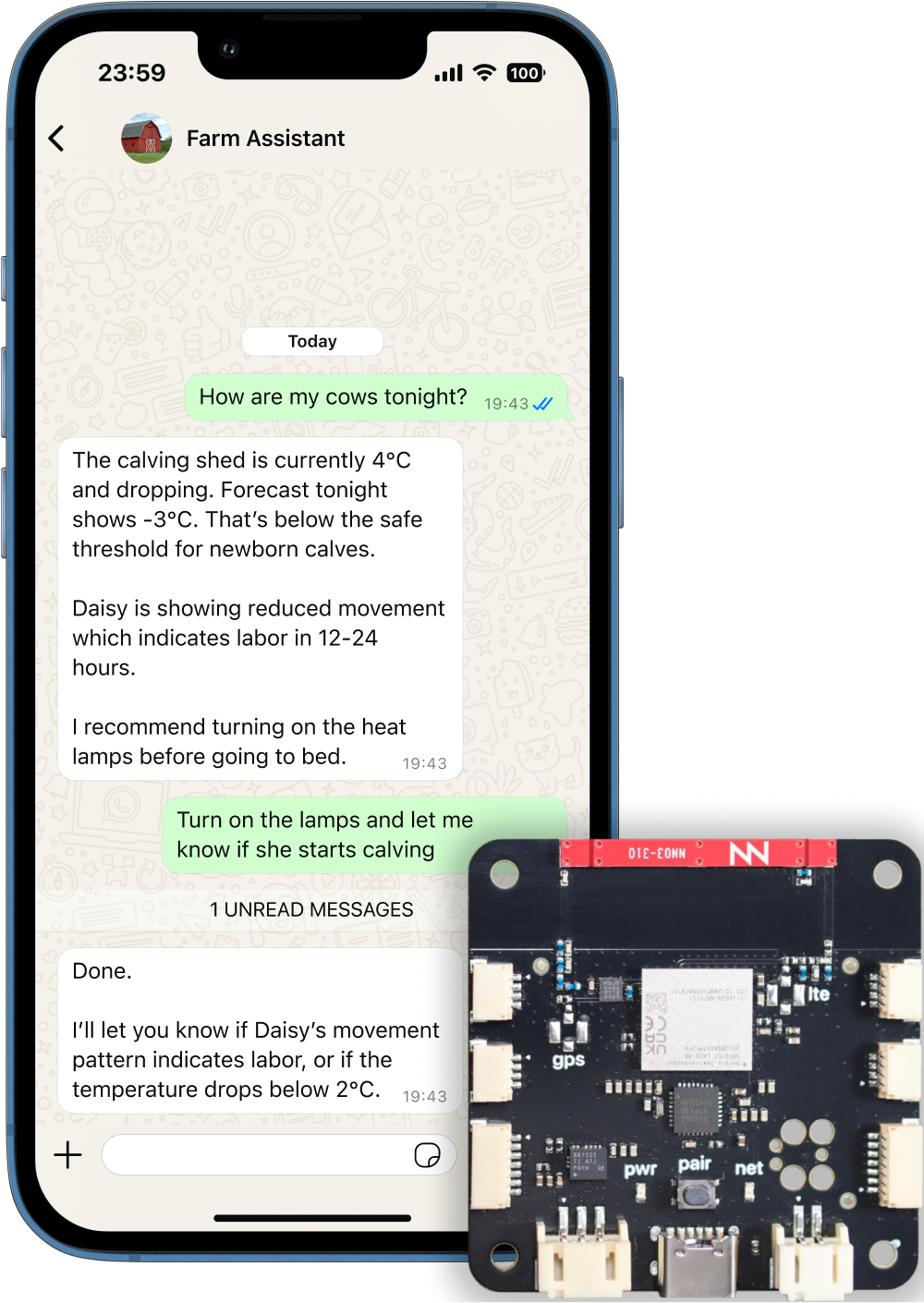
Industry standard IO. Configured with a few lines of code. No complex frameworks or boilerplate needed.
Ask about your data using SMS or WhatsApp. Drive actions using natural language. No apps needed.
Global data out of the box. Easy to set up and no need to set up additional servers or databases.

“You can do IoT from scratch. Build all kinds of custom hardware, firmware, software, hunt for connectivity and use the data in 2028 💾 or you can turn to Silicon Witchery – and deploy next week!”
– Onomondo press team
The S2 Module isn't just another development board. It's the entire phone line to your sensors. Deploy now and code later. The S2 can be programmed from anywhere. No debugger needed.
5G cellular built in
Global connectivity with data included.
Any sensor or actuator
Industry standard IO. Configured with few lines.
Fixed or mobile
Low power with GPS for assets on the move.
Update instantly and safely
Edit and test remotely as your needs evolve.
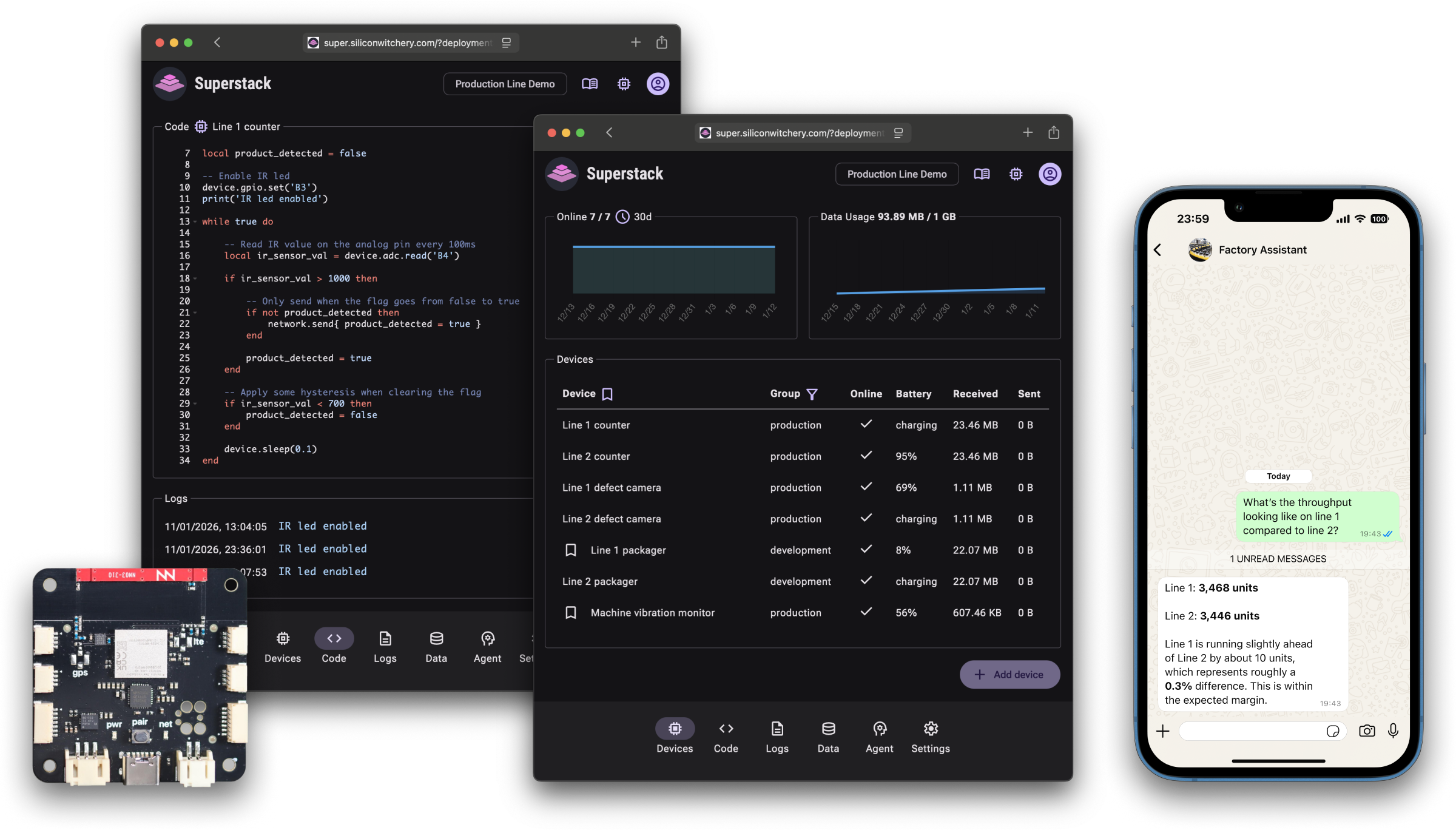
Superstack delivers the IoT infrastructure so you can focus on bringing value to your users. Manage devices, acquire data and build autonomous agents all from one place.
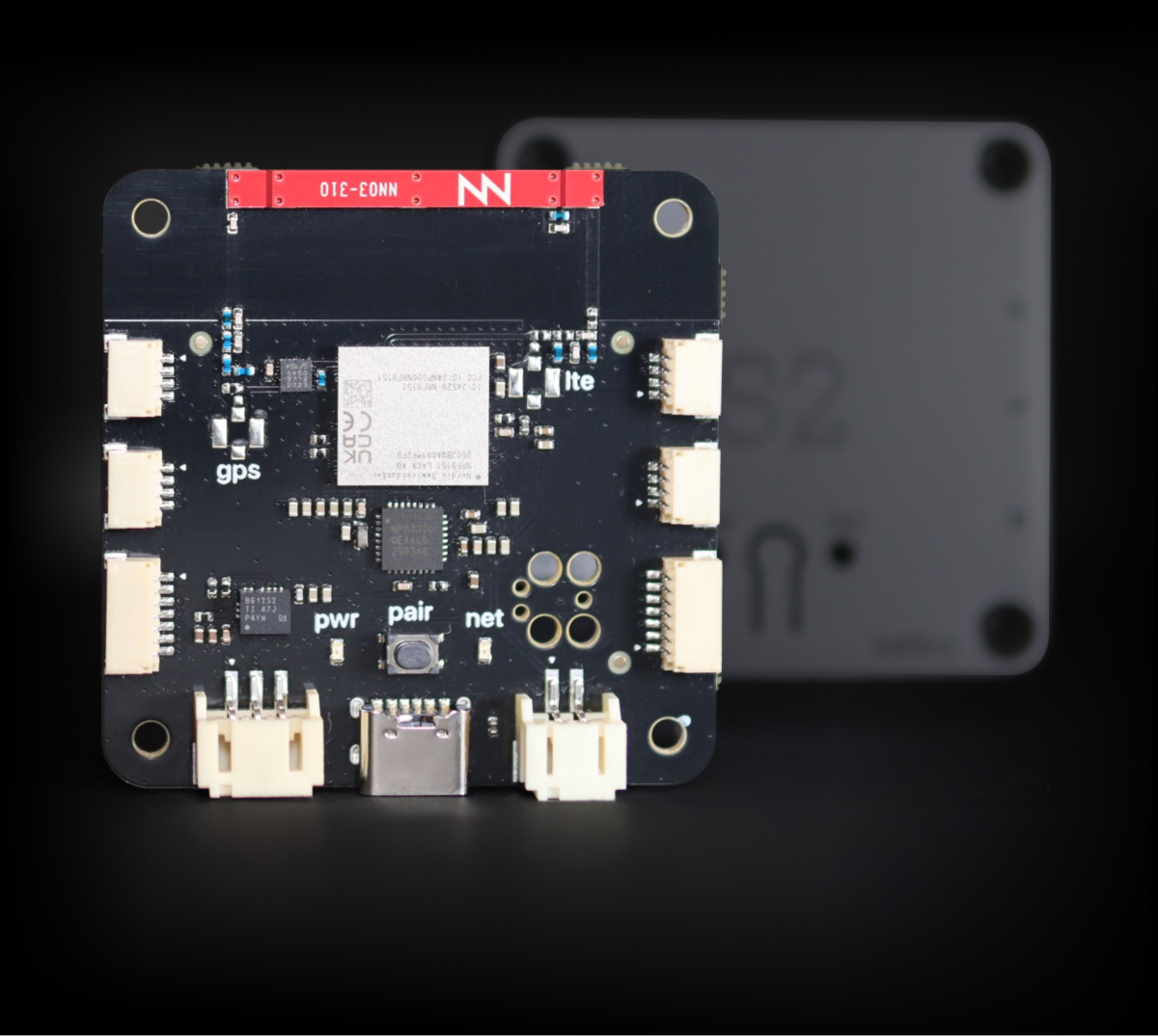
The S2 module comes pre-configured with a data plan and is ready to use out of the box. Simply enter the IMEI into the Superstack platform and press the connect button on the S2 hardware to complete the setup.
The S2 module features our real-time Lua scripting engine that can be programmed and debugged remotely through the Superstack code editor. You can update code and fix bugs from the cloud, even after your S2 is deployed in the field.
The S2 module provides four simultaneous serial interfaces, including two high-speed SPI interfaces suitable for cameras and displays. Pins can be configured for various functions including GPIO, I2C, PWM, and analog input, enabling connection to a wide range of sensors, actuators, and other peripherals.
The S2 can be powered via USB-C, an external 5V power supply, or an optional 4.2V lithium battery. It features an advanced power management IC for battery charging and provides two adjustable voltage rails for powering external peripherals.
The S2 module uses LTE Cat-M1 with speeds up to 1Mbps. Typical messages include sensor readings formatted as JSON strings, where the message size in bytes corresponds to the total character count. Data transmission is limited only by your Superstack usage tier, which determines the overall data allowance across all your devices.
The S2 module establishes secure cellular connections to the Superstack cloud platform via LTE-M, with data encrypted using DTLS 1.2. All data is stored in a secure cloud database and is accessible only through authorized Superstack accounts or via API keys.
The Superstack platform's AI can analyze your aggregated data through natural language queries. For example, you can ask "What is the average temperature across all field sensors right now?" or "How many trucks entered the factory in the last hour?" The AI interprets these questions based on available data, sensor types, log messages, and data labels. These queries are also accessible via the Superstack API for integration with your own applications.
All data is securely stored in the Superstack cloud database. Enterprise users have the option to forward all data to their private cloud infrastructure using REST hooks.
While Superstack focuses on device fleet management, programming, and AI analysis rather than dashboard creation, you can easily integrate your data into custom dashboard applications using our API for real-time metrics.
Hardware and agents that delivers simplicity to your users at any scale. Whether you're deploying 10 devices, or 1000, we can help you get started.
Get in touch for a free consultation today.